Low-carbon cement in 2026: calcination with CO₂ capture and alternative binders
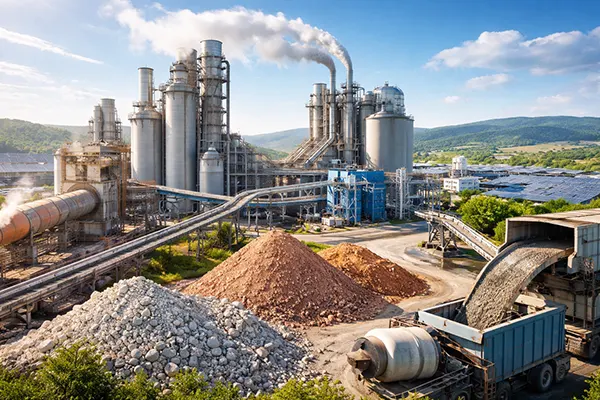
Cement is still one of the hardest construction materials to decarbonise, not because the industry “doesn’t care”, but because most emissions are baked into the chemistry of making clinker. In 2026, the practical route to lower-carbon cement is no longer a single technology: it is a stack of measures that reduce the clinker factor, cut fuel emissions, and—where scale and geology allow—capture process CO₂ at the kiln. This article breaks down what “calcination with CO₂ capture” actually means on a working plant, and where alternative binders such as LC3 and newer cement chemistries fit when you need reliable strength, durability and predictable supply.
Why cement is hard to decarbonise: the clinker problem
Most of cement’s CO₂ comes from calcination—heating limestone (CaCO₃) so it releases CO₂ and becomes lime (CaO), which later reacts with silica and alumina to form clinker minerals. That process CO₂ is fundamentally different from fuel CO₂: even if a kiln runs on low-carbon electricity or biomass, the chemical release still happens unless you change the raw mix or capture the gas.
On top of that, clinker needs very high temperatures (typically around 1,450°C in the burning zone), so thermal efficiency, fuel switching and heat recovery matter, but they cannot deliver deep cuts alone. Plants can reduce emissions intensity by lowering the clinker-to-cement ratio (using supplementary cementitious materials), yet availability and standards often cap how far this can go in real markets.
By 2026, the sector’s near-term “workhorse” measures are fairly clear: reduce clinker content, improve energy efficiency, use lower-emissions fuels where feasible, and treat carbon capture as the main lever for eliminating the remaining process emissions. That is why serious decarbonisation roadmaps increasingly combine lower-clinker binders with CCUS rather than betting on one silver bullet.
Calcination with CO₂ capture: what changes in the kiln line
CO₂ capture at a cement plant usually targets the concentrated exhaust streams around the preheater/precalciner and kiln, where CO₂ levels are higher than in many other industries. The capture technology can be post-combustion (amines or other solvents), oxyfuel (burning fuel in oxygen to create a CO₂-rich flue gas), or more specialised approaches such as calcium looping. Each option reshapes heat integration, electrical demand, and maintenance routines—so “just add capture” is never a minor retrofit.
The practical engineering challenge is not only the capture unit itself, but everything around it: flue-gas conditioning, dust handling, solvent management (for amines), steam supply, and compression/liquefaction before transport and storage. Capturing CO₂ also changes how operators think about kiln stability, because small shifts in oxygen levels, gas flows and moisture can ripple through clinker quality and fuel efficiency. In other words, capture is a process-control project as much as it is an emissions project.
A useful reality check is that industrial-scale cement CCS has moved from pilot talk to operating assets. Heidelberg Materials’ Brevik CCS in Norway has been presented as the first industrial-scale CCS facility in the cement industry, designed to capture around 400,000 tonnes of CO₂ per year and support production of a carbon-captured cement product (evoZero). That kind of reference matters because it anchors performance expectations: capture can be done at a cement plant, but it needs storage access, long-term contracts, and a full chain from capture to sequestration.
Lower-clinker binders that can scale: LC3 (limestone + calcined clay)
If you want a binder that reduces emissions without depending on a CO₂ transport and storage network, the strongest “scale candidate” in 2026 is limestone calcined clay cement (LC3). LC3 is a ternary system where part of the clinker is replaced with calcined clay and limestone, and the chemistry is designed so the alumina from the clay and the carbonate from limestone work together during hydration.
The practical attraction is supply: suitable clays and limestone exist in many regions, including places that do not have reliable slag or fly ash streams. LC3 can cut CO₂ materially by lowering clinker content, while keeping performance in ranges that concrete producers understand—provided the clay is properly selected and calcined. In technical literature and project communications, LC3 is often described as capable of significant emissions cuts compared with ordinary Portland cement, without needing a complete rebuild of the cement plant.
Adoption is no longer limited to lab trials. A visible 2025 example reported in the public domain is the use of LC3 on a major infrastructure project (Noida International Airport, India), which is the sort of application that forces disciplines like specification, QA/QC and supply logistics to prove themselves under pressure. That matters because low-carbon cement only “counts” when it can be poured, cured, tested and certified at scale.
Practical specification and quality control for LC3
LC3 performance is highly sensitive to clay reactivity and calcination control. In plain terms: “clay” is not a single material. Kaolinitic clays tend to produce reactive metakaolin when calcined, while other clays may need tighter process windows or deliver lower reactivity. Producers therefore monitor not just chemistry (XRF), but mineralogy and reactive alumina, because those parameters predict strength development and workability far better than total oxide percentages alone.
Calcination itself is a controllable, lower-temperature step compared with clinker burning, which opens interesting options for electrification and alternative heat sources. However, it still needs stable residence time, temperature uniformity, and dust management to avoid under- or over-burning the clay (both of which reduce reactivity). From a concrete producer’s perspective, consistency is the key: stable LC3 means predictable water demand, admixture compatibility and early-age strength, which in turn reduces the temptation to “fix” variability with extra cement.
Specification strategy also matters. Prescriptive standards sometimes restrict clinker substitution even when performance is acceptable, so many jurisdictions are moving—slowly—towards performance-based approaches that focus on durability and strength outcomes rather than exact ingredient lists. For project teams, that translates into a practical checklist: confirm cement type acceptance, require evidence (durability indices, permeability/RCPT or equivalent, sulfate resistance where relevant), and align curing and mix design with the cement’s strength development profile rather than assuming it behaves exactly like CEM I/OPC.
Alternative binders beyond Portland clinker: where they fit in 2026
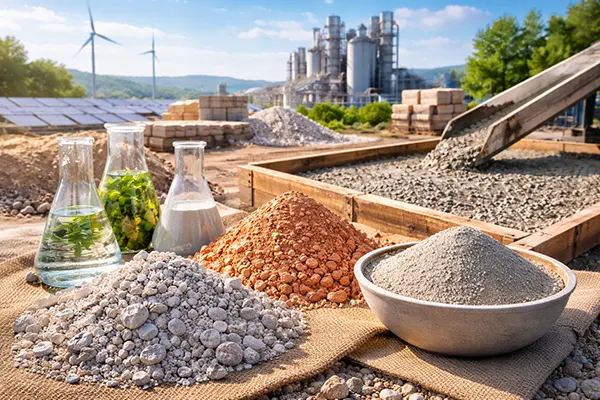
Beyond LC3, several alternative binder families are relevant in 2026, but they are not interchangeable. Calcium sulfoaluminate (CSA) cements can deliver fast strength and lower kiln temperatures than Portland clinker, which can translate into lower CO₂, especially when the raw mix is optimised. Belite-rich systems (including belite-ye’elimite-ferrite, BYF) are also researched because they can reduce limestone demand and process temperatures while maintaining practical strength development with the right formulation.
Alkali-activated binders (often called “geopolymer” in some contexts) can substantially reduce clinker demand by using aluminosilicate precursors such as slag, calcined clays, or other industrial minerals. Their real-world constraints are not only technical, but logistical: precursor availability, activator handling, consistent supply quality, and local codes that may not recognise these binders as “cement” for structural use. Where they do fit—precast elements, specialist concretes, or projects with strong owner oversight—they can be a serious option rather than a niche curiosity.
There is also a quieter class of solutions that reduce emissions at the concrete level, regardless of binder chemistry: optimised mix design, improved aggregate packing, and carbonation-related approaches (for example, CO₂ curing of certain products). These do not replace the need for low-carbon cement, but they change the “system boundary”: if a project can meet strength and durability with less binder per cubic metre, the embodied CO₂ drops even if the cement is not radically different.
How to choose the right low-carbon binder for a project
Start with the functional requirements, not the label on the bag. For structural concrete, that usually means characteristic strength at specified ages, durability exposure class, workability, and compatibility with reinforcement and admixtures. If the project is in a sulfate environment, freeze-thaw region, or marine exposure, the binder choice must be validated with evidence, not assumptions—especially when the cement chemistry differs from standard Portland systems.
Next, treat embodied carbon as a measurable parameter. In 2026, Environmental Product Declarations (EPDs) are widely used across many markets, and they let you compare like-for-like at declared system boundaries. The practical move is to specify a maximum global warming potential per tonne of cement (or per cubic metre of concrete) while still requiring performance tests. That forces the supply chain to compete on verified data rather than marketing claims, and it helps procurement teams avoid “green” products that do not actually deliver lower impacts.
Finally, manage risk with staged adoption. For many teams, the safest route is incremental: use LC3 or lower-clinker cements on less exposed elements first, verify production variability, then extend to structural pours once test history is built. For CCS-based cement, the key questions are different: continuity of capture operations, chain-of-custody for stored CO₂, and contractual clarity on how “captured” is documented. A low-carbon binder strategy works when it is backed by data, repeatable QA/QC, and a mix design that respects the chemistry rather than fighting it.