Biometrics on Personal Devices: Where Face ID and Fingerprint Data Are Stored
Biometric authentication has become a standard security mechanism on modern smartphones, laptops, and tablets. Face recognition and fingerprint scanning are now routinely used to unlock devices, authorise payments, and access sensitive applications. Despite their everyday use, many users remain uncertain about where biometric data is actually stored and how it is protected from misuse or external access.
How biometric authentication works on modern devices
Biometric systems on personal devices rely on mathematical representations rather than storing raw images of faces or fingerprints. When a user enrols Face ID or a fingerprint, the device converts physical features into encrypted templates generated by secure algorithms. These templates are used only for comparison during authentication attempts.
Modern biometric sensors operate entirely at the hardware level, separated from the main operating system. This design prevents applications, cloud services, or external software from accessing biometric information directly. Even system-level processes are restricted from reading or exporting biometric templates.
By 2026, biometric authentication has reached a maturity stage where accuracy is combined with strict data isolation. False acceptance rates have dropped significantly, while liveness detection methods help prevent spoofing attempts using photos, masks, or artificial fingerprints.
Local processing instead of cloud storage
Biometric data generated during enrolment never leaves the physical device. Face ID scans and fingerprint patterns are processed locally and stored in protected memory areas that are inaccessible to network interfaces. This approach eliminates the risk of interception during data transmission.
Manufacturers intentionally avoid synchronising biometric data across devices or accounts. Even when users restore devices from backups, biometric enrolment must be performed again, ensuring that templates are not transferred or copied.
This local-only architecture significantly reduces exposure to mass data breaches. Even if a user account is compromised, biometric credentials remain isolated and cannot be reconstructed remotely.
Secure enclaves and hardware-based protection
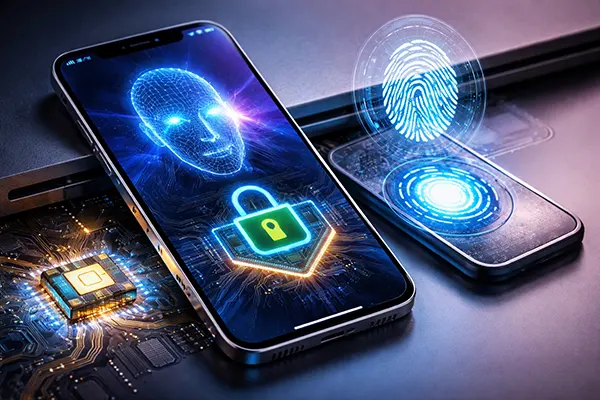
At the core of biometric security lies a dedicated hardware component often referred to as a secure enclave or trusted execution environment. This isolated processor handles biometric matching independently from the main system, ensuring that sensitive data is never exposed during normal device operation.
The secure enclave stores encrypted biometric templates using hardware-bound keys that cannot be extracted. These keys are generated during manufacturing and are unique to each device, making replication technically impractical.
By 2026, secure enclave architectures have been extended to cover additional functions such as on-device encryption, secure boot validation, and payment authentication, reinforcing overall device integrity.
Encryption and access control mechanisms
Biometric templates are encrypted using advanced cryptographic standards tied directly to the device hardware. Even if physical access to storage chips were obtained, the data would remain unreadable without the corresponding secure enclave keys.
Access to biometric verification is strictly limited. Only predefined system functions can request authentication, and they receive a simple confirmation response rather than biometric data itself.
This layered access control prevents both malware and legitimate applications from harvesting biometric information, maintaining a clear boundary between identity verification and software functionality.
User control, risks, and long-term considerations
Users retain full control over biometric authentication features. Face ID and fingerprint access can be disabled at any time, immediately rendering stored templates inactive. In such cases, devices revert to passcodes or passwords for security verification.
While biometric data cannot be changed like a password, modern systems mitigate this limitation by combining biometrics with device-specific encryption and fallback authentication methods. This reduces long-term risk even if biometric sensors are compromised.
Regulatory frameworks in multiple regions now classify biometric data as highly sensitive personal information. By 2026, device manufacturers are required to meet strict privacy and security standards governing biometric processing.
What users should realistically be aware of
The primary risk associated with biometrics lies not in data storage, but in user behaviour. Weak device passcodes or disabled security updates can undermine even the strongest biometric protections.
Biometric authentication should be viewed as one component of a broader security strategy. Regular software updates, secure lock settings, and awareness of physical access risks remain essential.
When implemented correctly, on-device biometric systems offer a practical balance between convenience and security, without exposing users to unnecessary data privacy threats.