AR Without a Headset: How Spatial Displays Create Digital Objects in Physical Space

Augmented reality is usually associated with smart glasses, phone cameras or headsets that place computer-generated content over a view of the physical world. Spatial displays take a different route. Instead of asking the viewer to wear hardware, they manipulate the light leaving a screen so that a digital object appears to have genuine depth when seen with the naked eye. By 2026, this idea has moved well beyond laboratory prototypes: commercial displays from Sony, Looking Glass and Samsung can present three-dimensional products, architectural models, medical visualisations and other digital content without conventional 3D glasses or an AR headset. The result should not be confused with a science-fiction hologram floating freely anywhere in a room. In most current systems, the apparent object remains linked to the display and a defined viewing area. Even with that limitation, spatial screens are changing how three-dimensional information can be presented in shops, museums, design studios, educational settings and other physical environments.
How Spatial Displays Create 3D Objects Without a Headset
A normal monitor sends essentially the same flat image towards both of a viewer’s eyes. The brain therefore receives only limited information about depth. A spatial display changes this relationship by presenting slightly different views of the same digital scene depending on where the viewer is looking from. The left eye may see a little more of one side of an object while the right eye receives another perspective. The brain combines those views in much the same way that it processes a physical object, producing a convincing sense of volume. If the system also changes the visible perspective as the viewer moves sideways, the effect becomes stronger because the object appears to respond naturally to movement rather than remaining fixed like an ordinary photograph.
This approach is often described as glasses-free or autostereoscopic 3D. The important difference from traditional stereoscopic cinema is that the screen itself handles the separation of views. There is no need for a pair of glasses to filter one image for the left eye and another for the right. Different manufacturers achieve this in different ways. Some displays direct many views into several angles at the same time. Others use cameras or sensors to determine the viewer’s position and continually adjust the image sent towards each eye. In both cases, the purpose is similar: provide enough visual information for the brain to interpret a computer-generated object as something with measurable width, height and depth.
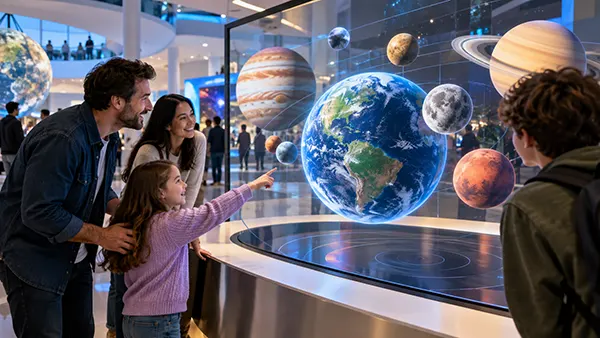
The phrase “AR without a headset” therefore needs some qualification. A conventional AR headset can place a digital chair on a real floor and keep it in the same physical position as the wearer walks around the room. Most spatial displays available in 2026 cannot reproduce that unrestricted experience. Their 3D content generally appears inside, behind or slightly in front of a specific display area. The surrounding room remains visible normally, but the screen acts as a spatial window through which the digital object is viewed. This narrower definition is nevertheless useful in situations where putting equipment on every visitor would be inconvenient. A person can approach a display, see depth immediately and then move on without fitting, cleaning, charging or configuring wearable equipment.
Light Fields, Multiple Views and Eye Tracking
Light-field displays are one of the clearest examples of this method. Rather than producing only one image of a 3D model, they generate a set of views showing the model from slightly different angles. Optical elements in front of the underlying panel direct those views towards different positions in front of the screen. Moving from left to right can therefore reveal another side of the digital object, creating what is known as motion parallax. Looking Glass uses this principle in its current light-field displays. Its 27-inch model can produce up to 100 perspectives across its viewing area, allowing more than one person to see three-dimensional content without individual head tracking or wearable hardware.
Eye-tracked spatial displays use a more personalised method. Sony’s 27-inch ELF-SR2 Spatial Reality Display includes a vision sensor that monitors the position of the viewer and adjusts the stereoscopic image accordingly. A micro-optical lens over the LCD then directs the appropriate image towards each eye. When the viewer changes position within the supported viewing area, the rendered perspective follows that movement. This gives the impression that a digital model is remaining in place while the person examines it from another angle. The method can provide precise spatial presentation, but it works best within a defined distance and viewing zone, which is why this type of display is particularly suited to individual professional work, demonstrations and controlled installations.
Not every glasses-free 3D screen uses the same optical arrangement. Samsung’s Spatial Signage, commercially launched worldwide in 2026, uses the company’s 3D Plate technology behind the LCD to create visible depth while retaining the familiar form of a relatively thin commercial screen. The intended effect is more like looking into an additional space behind the display than viewing an object projected into an unlimited area of the room. This distinction matters because terms such as “holographic”, “spatial” and “3D” are frequently used for technologies that operate quite differently. The common feature is not a particular optical component but the ability to give digital imagery a spatial quality that an ordinary flat screen cannot reproduce without additional viewing equipment.
Where Headset-Free Spatial Displays Are Being Used in 2026
One of the most practical uses is product visualisation. A spatial screen can present a shoe, vehicle component, piece of jewellery or industrial part as a rotatable digital model rather than a sequence of flat photographs. This can be useful when the physical item is too large, too fragile, too expensive or simply unavailable at a particular location. Samsung explicitly positions its Spatial Signage for retail, museums, luxury environments and entertainment venues, while Looking Glass offers its current light-field displays for retail installations, exhibitions, education and shared presentations. These applications benefit from low friction: visitors do not have to put on glasses before they can understand the visual effect.
Professional design is another area where spatial viewing already has practical value. Three-dimensional models are routinely created in automotive design, architecture, engineering and digital content production, yet they are commonly assessed on flat computer monitors. A spatial display lets designers judge depth and proportions without immediately producing a physical prototype. Sony, for example, provides tools for viewing CAD and BIM data on its Spatial Reality Display, and Subaru has used the ELF-SR2 as part of its vehicle design process. The advantage is not that a spatial screen replaces engineering measurements or physical testing. Instead, it gives teams another way to inspect details, scale and relationships that can be difficult to judge from a conventional two-dimensional image.
Museums, medical visualisation and education show how the same principle can serve purposes beyond commercial presentation. The National Museum of Western Art in Tokyo has used five Sony ELF-SR2 displays to present a three-dimensional model created from laser-scanned point-cloud data, allowing visitors to view the building without 3D glasses. Sony also lists specialised applications for medical and architectural data, including systems that turn conventional medical scans into manipulable 3D visualisations. In education, spatial displays can make structures such as anatomy, machinery, geography or molecular models easier to discuss because several layers of depth can be represented visually rather than inferred from a flat diagram. Their value depends less on visual spectacle than on whether the additional depth makes complicated information easier to understand.
What Current Spatial Displays Can Actually Do
Looking Glass illustrates how far multi-view light-field hardware has progressed. Its current 27-inch Light Field Display has a 5120 × 2880 panel, operates at 60 Hz and can generate up to 100 views across an optimal viewing cone of about 53 degrees. The smaller 16-inch model uses a 3840 × 2160 display and can also provide up to 100 views. This does not mean that every viewer receives the full native panel resolution as an independent 3D image, because the available pixels and optical information have to contribute to multiple perspectives. What the system gains in return is shared viewing: several people can stand within the useful viewing area and perceive changing perspectives without each person wearing a separate device.
Sony’s ELF-SR2 takes a different approach. It uses a 27-inch 3840 × 2160 LCD combined with a micro-optical lens system and viewer sensing. Sony specifies a normal viewing distance of approximately 50 to 100 centimetres, with 50 to 70 centimetres recommended, and a horizontal viewing range of about 25 degrees to either side. Those limits demonstrate an important reality of present-day spatial displays: their strongest three-dimensional effect is usually produced from particular positions rather than from anywhere in a room. For professional use this can be perfectly reasonable. A designer, doctor or client sitting in front of a dedicated display does not necessarily need a room-scale viewing zone if the object can be inspected naturally from the expected working position.
Samsung has taken glasses-free depth into a much larger signage format. Its 85-inch Spatial Signage entered global availability in February 2026 with a 4K UHD portrait panel measuring 2160 × 3840 pixels. A 32-inch version followed in April 2026, using a 1080 × 1920 portrait display intended for smaller product areas such as shelves and counters. These products are significant because they show spatial imagery moving beyond specialist desktop equipment into conventional commercial display locations. The objective is not full room-scale augmented reality; it is to give displayed content a stronger impression of depth while keeping installation closer to that of ordinary digital signage. That makes the technology easier to introduce into existing physical spaces than systems that require every visitor to carry dedicated hardware.
The Limits and Future of AR Without Wearable Hardware
The first major limitation is the viewing zone. A physical object can be observed from almost any direction, but a spatial screen can only send useful views across the angles its optical system supports. Move too far to one side, stand at the wrong height or leave the intended distance, and the 3D effect may weaken, change abruptly or disappear. Eye-tracked systems also depend on reliable detection of the viewer, while multi-view displays have to divide their available visual information across many perspectives. Manufacturers have improved these issues considerably, but they have not removed the underlying optical trade-offs. This is one reason current products are most convincing when the installation controls where people are likely to stand.
Content is another practical constraint. A flat photograph cannot automatically provide all the information required to show the hidden sides of an object. The strongest spatial presentations therefore begin with a real 3D model, a multi-view capture, depth information or content specifically prepared for the display. Software can estimate depth and create spatial effects from existing images, and conversion tools are becoming more capable, but generated depth is not the same as having complete geometry. A car designed in CAD can be shown accurately from many angles because the underlying model already contains its shape. A single photograph of the same car does not contain equivalent information about surfaces that the camera never captured.
Interaction also remains different from headset-based AR. A headset can combine cameras, head tracking, hand tracking and a mapped physical environment so that digital elements can respond to walls, tables, people and other real objects. A spatial display usually concentrates the experience around the screen itself. Touchscreens, controllers, hand sensors and other input devices can add interaction, but they do not automatically turn the surrounding room into a mapped mixed-reality environment. This is not necessarily a weakness. For a museum exhibit, medical model or retail demonstration, a defined interaction area may be simpler and more reliable than room-scale AR. The right comparison is therefore based on the task rather than on which technology produces the most dramatic visual effect.
Why Spatial Displays Are More Likely to Complement Headsets Than Replace Them
Future spatial displays are likely to become more convincing as viewing zones widen, optical efficiency improves and rendering systems become better at producing many perspectives without sacrificing as much image detail. Larger screens are also becoming practical. The transition visible between specialist desktop displays and Samsung’s commercial signage suggests that glasses-free depth can be adapted to very different viewing environments. At the same time, smaller light-field displays show how the technology can fit on desks, counters and interactive exhibits. Progress is therefore occurring across several display sizes rather than towards one universal device intended to replace every monitor, headset or projection system.
Software may prove just as important as optical hardware. Current products already work with common 3D workflows such as Unity, CAD, BIM and other content-creation tools, reducing the need to build every spatial experience from the beginning. Better depth estimation and image-processing methods can also make existing visual material easier to adapt, although professionally prepared 3D assets remain preferable when accurate geometry matters. Over time, the most useful improvement may be greater automation behind the scenes: a designer or museum curator should be able to prepare spatial content without having to understand the detailed optical behaviour of every display. When that happens, the technology becomes a presentation choice rather than a specialist technical project.
Headsets will still retain important advantages. They can provide a private image for each person, cover a much wider field of view and place digital content throughout a mapped physical environment as the wearer moves. Spatial displays offer a different set of benefits: nothing has to be worn, people can maintain normal eye contact with one another, access can be immediate and the display can become a permanent part of a physical location. By 2026, the most credible direction is therefore not a competition in which one technology eliminates the other. Headsets are better suited to personal and room-scale mixed reality, while spatial displays are increasingly useful wherever three-dimensional digital content needs to be visible quickly, naturally and with minimal equipment between the image and the viewer.