Photonic Neural Networks That Learn Directly on a Chip: A New Approach to Optical Computing in 2026
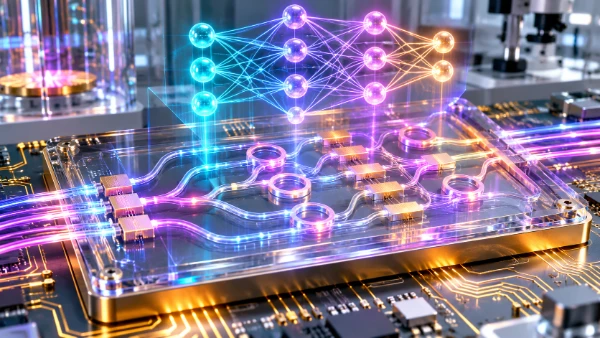
Artificial intelligence requires enormous computing resources, particularly when neural networks must process large amounts of information or adapt to unfamiliar tasks. Conventional electronic processors handle these operations efficiently, but increasing workloads create challenges involving energy consumption, memory access and heat generation. In 2026, researchers made important progress towards a different approach: photonic neural networks that use light to perform calculations and can learn directly through their physical circuits. Experiments published during the year demonstrated on-chip backpropagation, new methods of optical training and more sophisticated photonic processor designs. These developments do not mean that optical computers are ready to replace conventional AI hardware. They do, however, demonstrate that light can perform a more active role in machine learning than simply transmitting information between electronic components.
How Photonic Neural Networks Learn Directly on a Chip
Traditional neural networks learn by repeatedly adjusting the numerical connections between artificial neurons. During training, the system receives information, produces an answer and compares that answer with the expected result. It then calculates which internal adjustments would reduce the error. This procedure can involve billions of mathematical operations, particularly in large artificial intelligence models. Graphics processing units have become essential for such workloads because they can perform many calculations simultaneously. Nevertheless, considerable energy is required to move information between processors and memory. Photonic neural networks take a different approach by performing selected calculations through the physical behaviour of light travelling inside specially designed optical circuits.
A typical photonic neural network contains microscopic optical pathways known as waveguides. These structures guide light through a chip in much the same way that electrical connections carry signals through conventional processors. Other components, including modulators and interferometers, control the intensity and phase of optical signals. When light waves interact, their combined behaviour can represent mathematical operations used by neural networks. For example, optical interference can perform weighted combinations of input values, allowing a circuit to process several pieces of information simultaneously. Some designs also use different wavelengths of light to carry separate signals through shared components. This creates opportunities for parallel processing, although the practical benefits depend on the architecture and the amount of additional electronic equipment required.
The main difficulty has traditionally been training these optical circuits. Many earlier photonic neural networks relied on software simulations to determine suitable settings before transferring those settings to physical hardware. However, real optical components rarely behave exactly as their computer models predict. Tiny manufacturing differences can affect how light moves through a circuit, while temperature changes and optical losses may introduce further variations. A neural network that performs well in simulation can therefore produce less accurate results when implemented on a manufactured chip. On-chip learning addresses this problem by adjusting the network according to the behaviour of its actual physical components. Rather than depending entirely on an idealised digital representation, the training process takes account of the optical device as it operates.
On-Chip Backpropagation and the 2026 Nokia Bell Labs Breakthrough
Backpropagation is one of the most important learning techniques in modern artificial intelligence. After a neural network produces an output, the method calculates how individual connections contributed to the difference between the predicted and expected results. This information allows the system to adjust its parameters and improve subsequent predictions. Implementing backpropagation with light is challenging because training requires more than ordinary forward calculations. The network must also support the mathematical operations needed to determine parameter updates, including nonlinear functions that allow it to recognise complicated relationships. For many years, performing these operations directly in photonic hardware remained difficult, forcing researchers to rely on substantial external electronic processing.
In March 2026, researchers at Nokia Bell Labs reported a major advance in Nature. Their study, titled Integrated Photonic Neural Network with On-Chip Backpropagation Training, demonstrated a photonic deep neural network capable of performing the linear and nonlinear neural calculations needed for backpropagation on a single optical chip. The researchers used gradient-descent training, allowing the network to modify its internal settings in response to errors. In experimental nonlinear classification tasks, the device achieved accuracy exceeding 90%, comparable with the reference digital model used in the study. The system also demonstrated robustness against variations introduced during chip manufacturing. This was an important result because it showed that physical imperfections did not necessarily prevent an optical neural network from learning successfully.
The experiment did not eliminate electronic components from the complete system. Supporting equipment, including a microcontroller, memory and electronic control circuitry, remained necessary to coordinate training and manage information. The significant achievement was that the optical chip itself performed the essential neural computations involved in both forward and backward processing. This reduced dependence on an external digital model for calculating the network’s internal learning operations. The distinction is important when assessing claims about optical artificial intelligence. The 2026 demonstration established a working method for training a neural network through integrated photonic hardware, rather than proving that a fully optical general-purpose AI computer had been developed. It provides a foundation for future research into more autonomous and adaptable optical processors.
Major Advances in Optical Neural Network Technology in 2026
Researchers pursued several approaches to making photonic neural networks more capable during 2026. One of the most significant developments concerned the way optical circuits calculate the adjustments required during training. In October, Nature Computational Science published research introducing a method known as INSPIRE, short for In Situ Photonic Gradient Estimation. The technique allows information about learning gradients to be obtained from measurements of the actual optical system. This is particularly useful because complex photonic circuits may contain physical characteristics that are difficult to reproduce accurately in software. By using information gathered directly from the device, researchers can train optical hardware without depending on a complete mathematical model of every component.
INSPIRE uses a measurement technique involving synthetic time-reversal holography to analyse how light propagates through an optical circuit. This information helps determine how changes to individual settings will influence the network’s output. The researchers demonstrated optical matrix training with a relative error of approximately 0.26%, indicating high precision under the reported experimental conditions. They also explored learning through optical scattering structures and investigated meta-learning, a method intended to help systems adapt more quickly to new tasks. One experiment reported 251-fold model compression and a 136-fold acceleration in task-specific training compared with the particular reference approach used in the research. These results should not be interpreted as universal improvements over conventional AI processors, but they illustrate the potential of learning methods based directly on physical optical measurements.
A separate development reported in April 2026 involved a programmable three-dimensional photonic neural network fabricated inside glass using femtosecond laser writing. Unlike conventional optical circuits, which generally arrange their connections across a relatively flat surface, this design used pathways extending through a three-dimensional structure. The experimental device featured eight layers and an 8-by-8 channel arrangement. When evaluated using the MNIST handwritten-digit recognition benchmark, it achieved approximately 93% classification accuracy. The researchers also reported computational throughput of 6,554 trillion operations per second according to their experimental assessment. This architecture was not equivalent to the on-chip backpropagation system demonstrated by Nokia Bell Labs. Nevertheless, it showed how three-dimensional optical connections could provide additional options for constructing larger and more complex photonic computing devices.
What the Latest Experiments Reveal About Speed and Energy Efficiency
The experimental results reported in 2026 demonstrate meaningful progress, but their significance depends on how performance is measured. Classification accuracy exceeding 90% confirms that an optical system can successfully perform a particular learning task, yet it does not establish that the device can compete with advanced commercial AI accelerators across all applications. Tasks involving handwritten digits or relatively small classification problems are considerably less demanding than training large language models. Similarly, an impressive number of optical operations per second may describe the mathematical capacity of a specialised circuit rather than the performance of a complete computing system. Evaluating photonic hardware therefore requires comparisons that account for task complexity, numerical precision, processing speed and the equipment needed to operate the device.
Energy efficiency remains one of the strongest motivations for optical computing. Light can perform certain mathematical transformations through interference and propagation, potentially reducing the energy required for repeated numerical operations. Optical circuits may also process several signals concurrently, allowing greater use of parallel computation. However, producing and controlling light requires electrical energy. Lasers, photodetectors, signal converters and control electronics all contribute to total consumption. Some optical devices also require thermal management to maintain stable performance. Consequently, the efficiency of an individual photonic component cannot be treated as the efficiency of an entire processor. The most meaningful comparisons measure the energy required to complete a specific task at a defined accuracy, including all necessary optical and electronic operations.
Another important study published in Nature Communications in June 2026 demonstrated a photonic mixture-of-experts architecture. The experimental design contained three parallel optical processing cores and 18 computational kernels, allowing different optical components to specialise in particular operations. Across three image-classification tasks, the researchers reported an average accuracy of 97.1%. Their approach also reduced the number of digital backend parameters by 67% compared with the reference design used in the study. Unlike systems trained through physical backpropagation during operation, the optical structures in this architecture were primarily configured using training completed before fabrication. This illustrates the diversity of current photonic research. Some technologies aim to perform learning directly on optical hardware, while others focus on accelerating particular calculations using preconfigured optical components. Both approaches may prove useful, but they address different engineering problems.
Real-World Applications and the Future of Photonic AI Chips
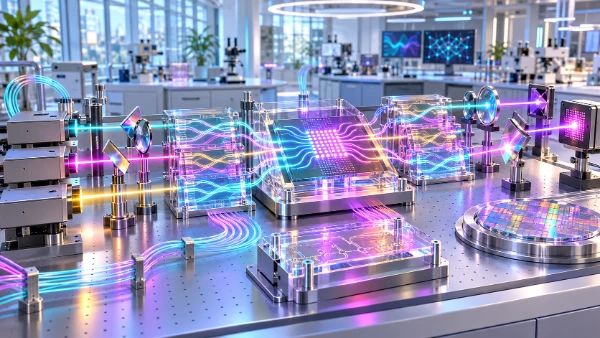
High-speed image processing is among the most promising applications for photonic neural networks. Optical circuits can potentially analyse several signals simultaneously, which may be valuable in industrial inspection, scientific imaging and specialised computer vision systems. For example, manufacturing equipment often needs to identify defects or unusual patterns in large quantities of visual information. A dedicated optical processor could perform selected recognition or filtering operations close to the point where the data is captured, reducing the amount of information transferred to other computing components. Similar possibilities exist in telecommunications, where optical signals already carry considerable volumes of data. Processing certain information directly in optical hardware could reduce conversion between optical and electrical forms, although this advantage depends on the design of the complete system.
Adaptive robotics and automated control represent another area of interest. Intelligent machines must often respond to changing conditions, including variations in lighting, movement and their surrounding environment. A neural network capable of adjusting its physical parameters could potentially adapt to certain changes without repeatedly transferring all its learning calculations to a separate computer. In March 2026, researchers described a photonic spiking neural system involving two specialised chips, including a programmable optical network and a laser-based component supporting nonlinear operations. The system was tested using reinforcement-learning tasks such as CartPole and Pendulum, which are commonly used to evaluate control algorithms. These laboratory experiments demonstrated that optical hardware could participate in learning and decision-making processes, although they did not establish suitability for commercial autonomous vehicles or industrial robots.
Data centres could eventually benefit from specialised photonic AI accelerators, particularly where large numbers of similar mathematical operations must be performed. Optical interconnections already play an important role in high-bandwidth communications, and optical computation offers the possibility of processing selected information without relying exclusively on electronic arithmetic units. A realistic future design may combine photonic processors with conventional graphics processing units and electronic memory. Optical components could handle suitable matrix operations, while electronic processors manage storage, scheduling, programming and more flexible calculations. This hybrid approach would make use of the strengths of both technologies rather than attempting to replace all existing hardware. Commercial adoption would depend on whether the resulting systems provide measurable advantages in cost, performance and energy consumption under practical operating conditions.
Technical Challenges and What to Expect Beyond 2026
Despite the progress achieved in 2026, scaling photonic neural networks remains difficult. Optical circuits become increasingly complicated as additional neurons, connections and adjustable parameters are introduced. Every component can contribute optical losses, while small manufacturing differences may alter the behaviour of the complete network. Temperature changes are another concern because some photonic components are sensitive to their surrounding conditions. In-situ training offers a way to compensate for certain imperfections, but it cannot remove all physical limitations. Larger systems will require efficient methods of controlling optical signals while maintaining reliable performance. Researchers must also improve manufacturing consistency and develop practical ways to connect increasingly complex photonic circuits without introducing excessive losses or additional energy costs.
Memory and programmability present further obstacles. Conventional AI processors can store large quantities of information and execute many different types of instructions. Photonic circuits are particularly attractive for certain mathematical transformations, but providing equally flexible storage and control entirely through optical components is considerably more difficult. As a result, most experimental systems continue to depend on electronics for important supporting functions. Software development also remains a challenge. Engineers need tools that can translate neural network models into optical circuit settings, test how those circuits behave and adjust them when necessary. The absence of widely adopted development methods makes practical integration more complicated. Long-term reliability, maintenance requirements and manufacturing costs will be just as important as laboratory processing speed when determining whether photonic processors can become commercially useful.
By November 2026, photonic neural networks had progressed beyond the simple demonstration of optical mathematical operations. The Nokia Bell Labs research established that integrated optical hardware could perform the neural calculations required for backpropagation, while INSPIRE demonstrated a precise method for learning from physical measurements of optical circuits. Advances in three-dimensional integration, parallel optical processing and photonic reinforcement learning revealed additional ways of developing the technology. However, these achievements remain experimental and do not yet demonstrate a universal advantage over established electronic AI hardware. The next important milestones will involve larger neural networks, demanding real-world benchmarks, complete-system energy measurements and reliable manufacturing methods. If researchers can address these challenges, photonic neural networks may become valuable specialised components of future computing systems, allowing light and electronics to share the demanding work of artificial intelligence.