Quantum Sensors: How Ultra-Precise Measurements Are Transforming Medicine, Navigation and Industry
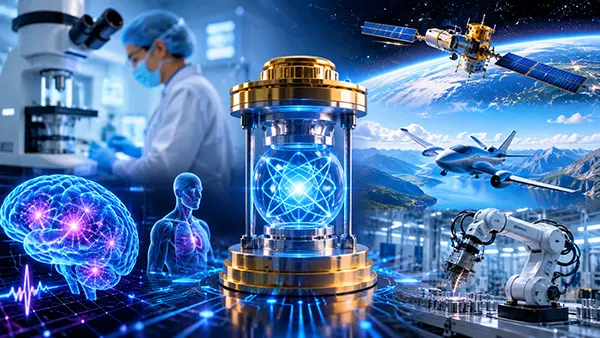
Quantum sensing is emerging as one of the most practical applications of quantum technology. While quantum computing often attracts public attention, quantum sensors are already being used in laboratories, hospitals, industrial facilities and advanced navigation systems. By exploiting quantum properties such as superposition and entanglement, these devices can detect changes in magnetic fields, gravity, acceleration and time with extraordinary precision. As of 2026, governments, research institutions and technology companies are investing heavily in quantum sensing because it offers measurable advantages in real-world environments where conventional instruments are approaching their physical limits.
The Scientific Principles Behind Quantum Sensors
Quantum sensors operate by measuring tiny changes in the behaviour of atoms, ions, photons or other quantum systems. Unlike traditional sensors, which rely on classical physical effects, quantum devices use the sensitivity of quantum states to external influences. Even extremely small disturbances can be detected and translated into highly accurate measurements.
One of the most widely used approaches involves atomic interferometry. In these systems, laser-cooled atoms are manipulated using laser pulses, creating wave-like interference patterns. Changes in gravity, motion or acceleration alter these patterns, allowing researchers to measure physical phenomena with remarkable accuracy. Atomic interferometers are now being developed for applications ranging from underground mapping to autonomous navigation.
Another important category includes quantum magnetometers. These instruments can detect minute magnetic field variations that would be invisible to many conventional sensors. Nitrogen-vacancy centres in diamonds have become particularly valuable because they can function at room temperature while maintaining exceptional sensitivity. This makes them suitable for medical diagnostics, materials science and industrial inspection.
Why Precision Matters More Than Ever
Many modern technologies depend on measurements that are approaching the limits of conventional instruments. Whether tracking subtle biological signals, monitoring structural integrity or navigating without satellite support, small measurement errors can lead to significant consequences. Quantum sensors provide a pathway to reducing these uncertainties.
Improved precision also enables entirely new forms of observation. Scientists can monitor phenomena that were previously hidden by measurement noise, including microscopic magnetic activity within living tissue and tiny gravitational changes beneath the Earth’s surface. These capabilities expand both scientific research and commercial opportunities.
The importance of precision continues to grow as industries adopt automation, artificial intelligence and advanced robotics. More accurate data allows machines to make better decisions, reduces operational risks and improves overall system performance. Quantum sensing therefore represents not only a scientific achievement but also an economic advantage.
Applications in Modern Healthcare and Medical Research
Healthcare is among the sectors expected to benefit most from quantum sensing technologies. Traditional diagnostic equipment has improved significantly over recent decades, yet many biological processes remain difficult to observe in sufficient detail. Quantum sensors are helping researchers overcome these limitations.
One promising development involves ultra-sensitive magnetoencephalography systems. These devices measure the magnetic fields generated by brain activity. Quantum magnetometers can often provide higher sensitivity while reducing the need for complex cooling systems associated with conventional superconducting equipment. This may eventually lead to more accessible neurological diagnostics.
Researchers are also investigating quantum sensors for cardiac monitoring, cancer detection and advanced medical imaging. The ability to identify subtle physiological changes at earlier stages could improve diagnostic accuracy and support more personalised treatment strategies. Several clinical trials and pilot projects across Europe, North America and Asia are evaluating these possibilities in real healthcare environments.
From Research Laboratories to Clinical Practice
Although many quantum medical technologies remain in development, the transition from laboratory prototypes to clinical use is accelerating. Improvements in miniaturisation, manufacturing techniques and software integration are making quantum devices more practical for hospitals and research centres.
Regulatory approval remains an important challenge. Medical equipment must demonstrate reliability, safety and reproducibility before widespread adoption. Researchers are therefore focusing not only on performance improvements but also on ensuring that quantum sensors can operate consistently in everyday clinical settings.
As healthcare systems seek earlier disease detection and more accurate monitoring tools, quantum sensing may become an important component of next-generation medical infrastructure. The technology is unlikely to replace existing diagnostic methods entirely, but it has the potential to complement and enhance many established procedures.
Transforming Navigation, Manufacturing and Industrial Operations
Navigation is another field where quantum sensing is attracting substantial attention. Most modern navigation systems rely heavily on Global Navigation Satellite Systems (GNSS), including GPS. However, satellite signals can be disrupted, blocked or deliberately interfered with. Quantum inertial sensors offer an alternative approach by measuring movement and acceleration with exceptional accuracy.
Military organisations, aerospace companies and transportation developers are investing in quantum navigation technologies that can operate independently of external signals. Aircraft, ships and autonomous vehicles equipped with advanced quantum sensors may eventually maintain accurate positioning even in environments where satellite coverage is unavailable or unreliable.
Industrial applications are equally significant. Quantum gravimeters can identify underground structures, mineral deposits and infrastructure changes without excavation. Energy companies, construction firms and environmental monitoring organisations are exploring these capabilities to improve efficiency while reducing operational costs.
The Future Commercial Impact of Quantum Sensing
Market analysts expect the global quantum sensing sector to expand significantly throughout the second half of the 2020s. Growth is being driven by increasing demand for precision measurement technologies across healthcare, defence, aerospace, manufacturing and scientific research.
Several technical challenges remain. Quantum devices often require sophisticated control systems, specialised components and highly stable operating conditions. However, ongoing advances in photonics, materials science and quantum engineering are steadily reducing these barriers.
By 2026, quantum sensors have already moved beyond theoretical research and into practical deployment across multiple industries. As development continues, these technologies are expected to deliver more accurate measurements, improved operational resilience and new capabilities that were previously impossible to achieve with classical sensing methods. Their influence is likely to become increasingly visible in medicine, navigation and industrial innovation over the coming decade.