Autonomous Robot Swarms: How Hundreds of Simple Machines Coordinate Without Central Control
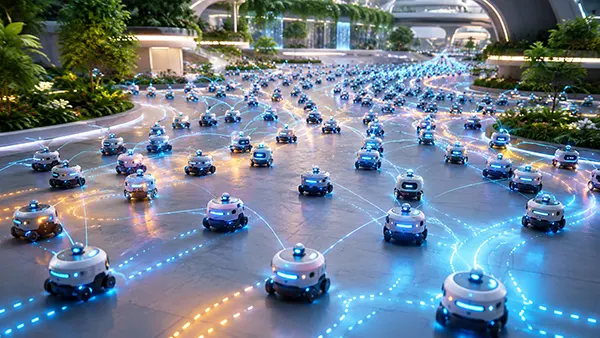
A robot swarm can look surprisingly organised even when no single machine knows what the whole group is doing. Instead of relying on one computer to issue instructions to every unit, swarm robotics borrows ideas from ant colonies, bird flocks and schools of fish. Each robot observes a small part of its surroundings, follows a limited set of rules and reacts to nearby machines. When hundreds of robots repeat these actions at the same time, coordinated behaviour can emerge across the entire group. This approach has moved well beyond computer simulations. Researchers have demonstrated self-organising groups containing more than a thousand physical robots, while newer projects are testing decentralised movement, cooperative exploration and autonomous navigation in increasingly realistic conditions. By 2026, the main question is no longer whether machines can coordinate without constant central supervision, but how reliably these methods can work outside controlled laboratories.
Why a Robot Swarm Does Not Need a Central Controller
Traditional multi-robot systems often work through a central computer. That computer receives information from individual machines, decides what each one should do and sends instructions back. The arrangement can provide predictable control, but it becomes more demanding as the number of robots grows. Communication traffic increases, the central computer has more information to process and a failure in one important component may affect the whole group. Swarm robotics takes a different approach. Individual robots are expected to make many decisions themselves, usually using information collected from their immediate surroundings rather than a complete map of the entire group.
The rules followed by each robot can be remarkably simple. A mobile unit might be told to maintain a safe distance from its neighbours, move in approximately the same direction as nearby robots, approach an area where a useful signal becomes stronger or pass information to machines within communication range. None of those actions requires the robot to understand the full purpose of every other member of the group. It only needs enough information to choose its next movement. When the same behaviour is repeated across tens, hundreds or thousands of machines, local reactions can produce organised movement, shape formation, area coverage or collective searches.
Decentralised control does not mean that a swarm has no goals or rules. Engineers still define the mission, safety limits and behaviour of the robots before deployment. Some systems can also assign temporary leadership roles when a particular task requires them. The important difference is that routine decisions do not have to travel continuously through one permanent command point. A robot can react to an obstacle, change its route or coordinate with neighbours locally. This reduces dependence on continuous communication with a remote operator and can make a large group more tolerant of individual delays, communication gaps or failed machines.
From 1,024 Kilobots to Vision-Only Flocking
One of the clearest demonstrations of large-scale swarm behaviour came from Harvard researchers Michael Rubenstein, Alejandro Cornejo and Radhika Nagpal. Their Kilobot experiments used a group of 1,024 small robots capable of assembling into predetermined two-dimensional shapes. Each Kilobot was intentionally simple. It used vibration motors for movement and infrared light for short-range communication and distance sensing. The robots did not receive precise global positions. Instead, they relied on nearby machines, local distance measurements and information passed through the group. Their collective algorithm allowed the swarm to build an internal coordinate system and gradually organise itself into the required shape.
The importance of the Kilobot experiment was not simply its size. Individual robots were relatively limited and their movement was imprecise, yet the group could still produce useful organised behaviour. A slow or inaccurate robot did not automatically stop every other machine. This demonstrated an important principle of swarm engineering: reliability can sometimes come from cooperation and redundancy rather than from making every individual unit extremely sophisticated. Cheap, limited machines become more useful when the group is designed to tolerate variation between them.
Research published in 2025 provided a more recent example of decentralised coordination based almost entirely on perception. A team demonstrated collective movement with ten terrestrial robots that used their onboard cameras to detect nearby robots and make movement decisions. During the experiments, the robots did not receive movement information from a central computer and did not explicitly exchange their internal states. Each unit processed its own camera stream and calculated motor commands onboard. Ten robots are far from a thousand-unit swarm, but the experiment addresses an important real-world problem: creating coordinated movement without requiring external positioning data or constant digital communication between every member of the group.
How Robots Share Information, Divide Work and Reach Group Decisions
A swarm does not need every robot to communicate with every other robot at every moment. Information can spread gradually from one neighbour to another. For example, a robot that detects an obstacle, target or useful measurement can send a short message to nearby units. Those machines can respond locally or relay relevant information further through the group. A similar principle is found in social insects, where an individual ant does not receive instructions from an authority controlling the entire colony. Local signals influence local decisions, and repeated interactions affect the behaviour of the larger group.
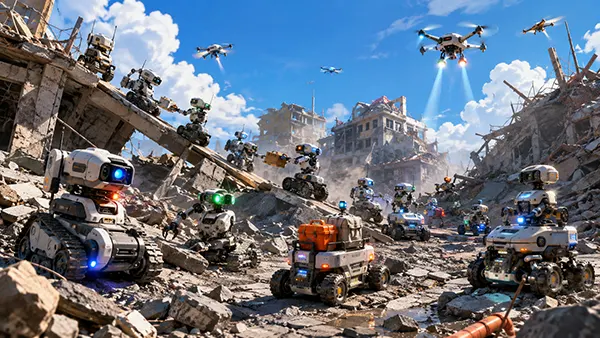
Work can also be allocated without preparing a permanent list of duties for every machine. A robot close to an unexplored area may take responsibility for surveying it, while another with a stronger sensor reading may continue investigating a possible target. Battery level, distance, available sensors, current workload and communication quality can all influence such decisions. If one robot becomes unavailable, nearby units can redistribute some of its work. This flexible allocation is particularly useful when conditions cannot be predicted accurately before deployment, such as after a natural disaster or during exploration of unfamiliar terrain.
Movement creates another coordination problem. Hundreds of robots cannot simply choose the shortest route to the same destination because they would interfere with one another. Swarm behaviour therefore includes rules for spacing, direction and collision avoidance. A machine may slow down when another robot is too close, change direction when several neighbours turn or select a less crowded route. The goal is not always to calculate the mathematically perfect movement for the entire swarm. In many cases it is more practical to let individual robots make acceptable local choices that collectively keep the group moving without requiring one computer to calculate hundreds of trajectories continuously.
What Happens When Robots Lose Contact or Fail
One of the strongest reasons for studying swarm robotics is the possibility of graceful degradation. In a centrally controlled system, the failure of an important command or communication component can create a serious problem for all connected machines. A well-designed swarm should be less dependent on any one robot. If a unit stops moving, other robots can continue operating around it. If a sensor fails, measurements from neighbouring machines may still provide useful information. Losing one robot from a group of several hundred should reduce capacity rather than automatically end the mission.
Communication failures are more complicated because they can divide a swarm into temporary subgroups. Robots on opposite sides of an obstacle may no longer be able to exchange information directly. Decentralised systems can address this by allowing each subgroup to continue following local objectives until communication is restored. Messages can also move through intermediate robots in a mesh-like arrangement rather than relying on a direct connection to one transmitter. When separated groups meet again, they can exchange updated information and adjust their tasks. The exact solution depends on the environment, because radio links suitable for a warehouse may behave very differently underground, underwater or on another planetary body.
Decentralisation is not an automatic guarantee of reliability. A poor local rule can spread undesirable behaviour throughout the group just as easily as a useful rule can produce coordination. Robots may crowd the same route, interpret noisy sensor readings incorrectly or repeatedly respond to one another in a way that wastes time and energy. Large groups also create practical problems involving battery charging, maintenance, radio congestion and physical recovery of failed units. For this reason, serious swarm research includes repeated physical testing rather than relying only on simulations. Engineers need to know not only what a control method should do under ideal conditions, but how it behaves when real sensors, motors and communication links are imperfect.
Where Swarm Robotics Stands in 2026
Space exploration provides one of the clearest current examples of growing interest in cooperative autonomy. NASA’s Cooperative Autonomous Distributed Robotic Exploration project, known as CADRE, consists of three suitcase-sized lunar rovers and a base station. Three machines do not constitute a large swarm of hundreds, so CADRE is more accurately described as a multi-robot autonomy demonstration. Its importance lies in the way the rovers are designed to cooperate. They can divide work, plan safe routes, travel in formation and perform synchronised ground-penetrating radar measurements with limited dependence on commands from Earth. As of August 2026, NASA’s Jet Propulsion Laboratory continued to list CADRE as a future mission with a 2026 launch date, while the associated Intuitive Machines IM-3 lunar mission remained planned for 2026.
Environmental monitoring is another field where distributed robots could provide practical advantages. A single underwater vehicle can collect detailed measurements along its route, but multiple machines can examine different areas at the same time. Research published in Nature Communications in 2025 tested a swarm cooperation method in a simulated marine environment covering a six-kilometre-square area. Autonomous underwater vehicles were modelled searching for the highest concentration of a moving contaminant while dealing with marine currents. The work was a computational proof of concept rather than a completed field deployment, an important distinction, but it shows how researchers are developing decentralised methods for tasks in which the target itself may move or change over time.
At much smaller scales, 2026 research is examining autonomous navigation by microrobot swarms in unknown environments. A study published in Nature Machine Intelligence in June 2026 presented a control approach that allowed a magnetically actuated microrobotic swarm to perform navigation and obstacle-avoidance tasks under partial observation. The reported demonstrations included static and dynamic obstacle avoidance, cargo transport, tracking and recovery after temporary loss of visual information. Such work is particularly relevant to long-term medical research, although autonomous microrobot swarms should still be regarded as an experimental field rather than routine clinical technology. Moving from laboratory demonstrations to safe use inside the human body requires substantial additional validation and control.
Why Future Swarms Will Mix Simple Rules with Smarter Local Decisions
The direction of research in 2026 suggests that simple swarm rules and more capable onboard intelligence are likely to develop together rather than compete. Basic local behaviours remain valuable because they are computationally efficient and easier to test across large groups. A robot does not need a complex artificial intelligence model merely to keep a safe distance from its neighbour. More advanced software can instead be reserved for tasks where it provides a clear benefit, such as recognising terrain, interpreting camera images, identifying an unusual object or choosing between several possible local routes.
This creates a practical middle ground between complete remote control and completely independent machines. Human operators can define the overall mission and safety boundaries, while robots handle frequent local decisions themselves. A search-and-rescue swarm, for example, could receive a geographical area to inspect without requiring an operator to steer every robot. Individual machines could spread through accessible routes, share observations locally and redirect themselves around blocked areas. Humans would remain responsible for mission-level decisions, while the repetitive coordination required to operate a large group would be handled closer to the robots themselves.
The remaining challenge is reliability at scale. Research has already shown that large groups of simple robots can self-organise and that smaller groups can move using local perception without continuous central guidance. Current projects are extending those principles towards planetary exploration, environmental sensing and microrobotic navigation. Wider adoption will depend on proving that such groups can behave predictably when batteries weaken, sensors disagree, communication becomes unreliable or unexpected obstacles appear. The long-term value of swarm robotics is therefore not simply the ability to deploy hundreds of machines. It is the ability to make those machines cooperate in a way that remains useful even when no individual robot has a complete picture of the task.